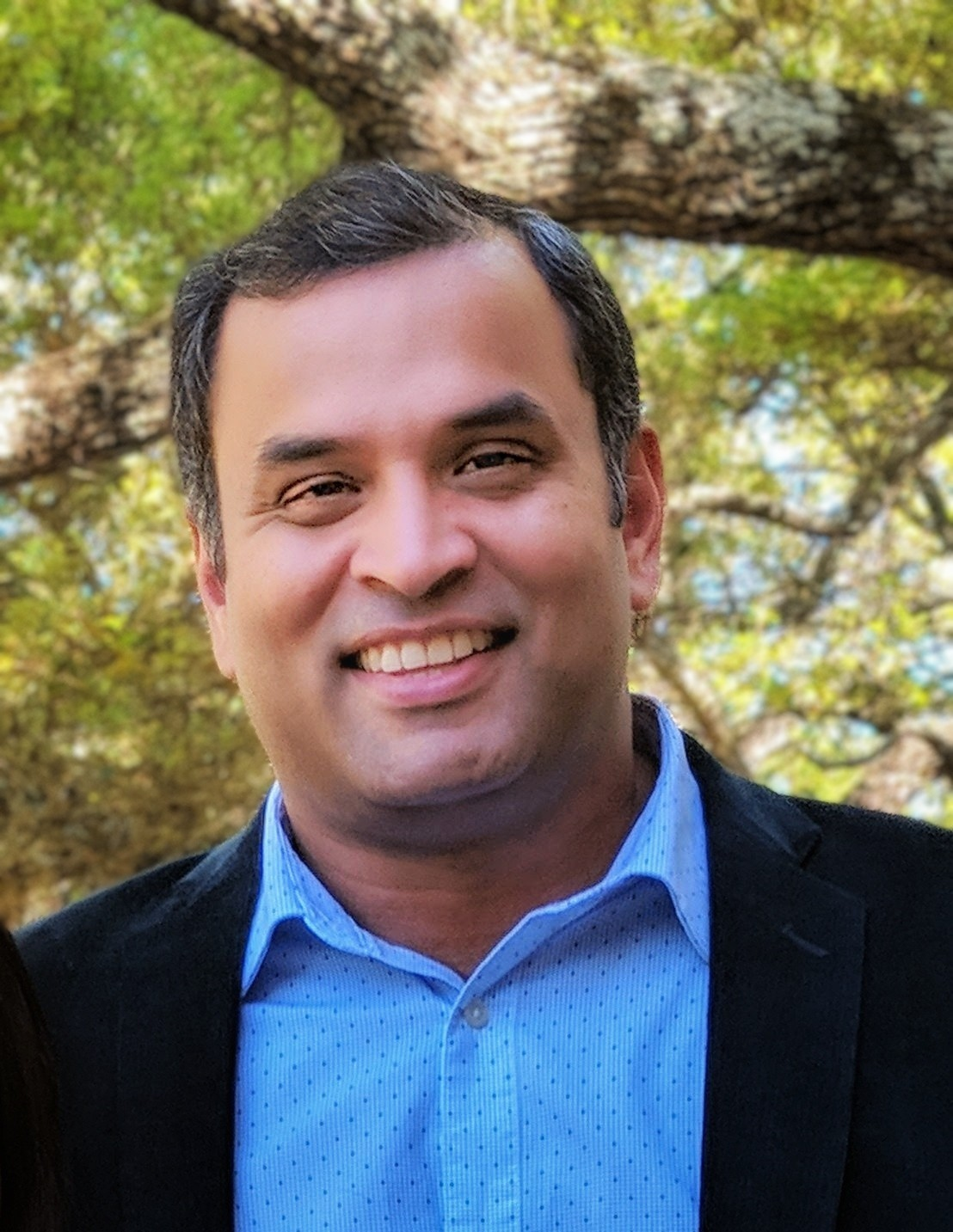
Portrait of Himanshu Save

Himanshu Save, Ph.D.

Senior Research Scientist

Center for Space Research (CSR)
The University of Texas at Austin

Profile

About

Himanshu Save is a Senior Research Scientist at the Center for Space Research (CSR), The University of Texas at Austin. His research focuses on satellite gravimetry, space geodesy, and the development of advanced gravity-field and mascon products from the GRACE and GRACE Follow-On missions.

He serves as Science Operations Manager for the GRACE Follow-On and upcoming GRACE-Continuity (GRACE-C) missions and leads the development of Science Data System capabilities for the GRACE-Continuity mission at CSR. His work spans operational gravity-field processing, mission operations, systems engineering, mission design, precise orbit determination, and collaboration with scientists studying terrestrial water storage, groundwater, drought, floods, ice-sheet mass change, ocean mass, sea-level change, and solid-Earth processes.

Areas of focus

Research Areas

Satellite Gravimetry

Development and analysis of gravity-field and mascon products from the GRACE and GRACE Follow-On missions to investigate the dynamics of the Earth system from satellite gravity measurements. Research includes global mass flux estimation, validation and interpretation, operational monthly and high-temporal-resolution gravity solutions, near real-time applications, and the development and analysis of gravity information for diverse Earth science applications.

Space Geodesy

Gravity-field estimation, precise orbit determination, satellite-to-satellite ranging, geodetic reference systems, and analysis of spaceborne geodetic measurements.

Science Data Systems

Development of operational processing systems, software, high-performance computing infrastructure, satellite systems, telemetry science monitoring, data quality control, calibration and validation, and science product generation for the GRACE, GRACE Follow-On, and GRACE-Continuity missions.

Earth System Science

Applications of satellite gravity observations to terrestrial water storage, groundwater, floods and droughts, ice sheets, ocean mass, sea level, and solid-Earth processes.

Future Missions and Systems Engineering

Science, systems engineering, mission architecture, simulation, and data-system development supporting GRACE-Continuity and future satellite gravimetry missions.

Recognition

Awards & Recognition

NASA Exceptional Public Service Medal

2020

National Aeronautics and Space Administration (NASA)

Awarded for exceptional service to NASA through contributions to GRACE and GRACE Follow-On science operations, mission data quality, and operational excellence.

International Award for Outstanding Achievement

2018

SpaceOps

Recognized as one of ten members of the international GRACE Operations Team (DLR GSOC, NASA JPL, and The University of Texas Center for Space Research) for outstanding achievement in mission operations.

NASA Group Achievement Award

2024

National Aeronautics and Space Administration (NASA)

Awarded for exceptional group achievement in the successful completion of the GRACE Follow-On five-year Prime Mission, recognizing the team's contributions to mission success and long-term science operations.

Fulbright Specialist

2023

U.S. Department of State

Selected as a Fulbright Specialist in recognition of expertise in satellite geodesy and Earth observation, supporting international collaboration, research, and capacity building.

Background

Education

Ph.D., Aerospace Engineering

The University of Texas at Austin

M.S., Aerospace Engineering

The University of Texas at Austin

B.Tech., Civil Engineering

Indian Institute of Technology Bombay

Research record

Selected Publications

Complete publication list on Google Scholar

  1. 2016
    High-resolution CSR GRACE RL05 mascons

    H. Save, S. Bettadpur, and B. D. Tapley. Journal of Geophysical Research: Solid Earth.

  2. 2019
    Contributions of GRACE to understanding climate change

    B. D. Tapley, M. M. Watkins, F. Flechtner, C. Reigber, S. Bettadpur, M. Rodell, I. Sasgen, J. S. Famiglietti, F. W. Landerer, D. P. Chambers, J. T. Reager, A. S. Gardner, H. Save, et al. Nature Climate Change.

  3. 2018
    Global models underestimate large decadal declining and rising water storage trends relative to GRACE satellite data

    B. R. Scanlon, Z. Zhang, H. Save, et al. Proceedings of the National Academy of Sciences.

  4. 2020
  5. 2016
    Global evaluation of new GRACE mascon products for hydrologic applications

    B. R. Scanlon, Z. Zhang, H. Save, D. N. Wiese, F. W. Landerer, D. Long, L. Longuevergne, and J. Chen. Water Resources Research.

  6. 2013
    GRACE satellite monitoring of large depletion in water storage in response to the 2011 drought in Texas

    D. Long, B. R. Scanlon, L. Longuevergne, A. Y. Sun, D. N. Fernando, and H. Save. Water Resources Research.

  7. 2019
    Global GRACE data assimilation for groundwater and drought monitoring: Advances and challenges

    B. Li, M. Rodell, S. Kumar, et al., including H. Save and S. Bettadpur. Water Resources Research.

  8. 2020
    Extending the global mass change data record: GRACE Follow-On instrument and science data performance

    F. W. Landerer, F. M. Flechtner, H. Save, et al. Geophysical Research Letters.

  9. 2020
    Return to rapid ice loss in Greenland and record loss in 2019 detected by the GRACE-FO satellites

    I. Sasgen, B. Wouters, A. S. Gardner, et al., including H. Save. Communications Earth & Environment.

  10. 2019
    GRACE accelerometer data transplant

    T. Bandikova, C. McCullough, G. L. Kruizinga, H. Save, and B. Christophe. Advances in Space Research.

  11. 2016
    High-frequency terrestrial water storage signal capture via a regularized sliding window mascon product from GRACE

    C. Sakumura, S. Bettadpur, H. Save, and C. McCullough. Journal of Geophysical Research: Solid Earth.

  12. 2023
    Mass balance of the Greenland and Antarctic ice sheets from 1992 to 2020

    I. N. Otosaka, A. Shepherd, E. R. Ivins, et al., including H. V. Save. Earth System Science Data.

  13. 2021
    Effects of climate and irrigation on GRACE-based estimates of water storage changes in major U.S. aquifers

    B. R. Scanlon, A. Rateb, D. R. Pool, W. Sanford, H. Save, et al. Environmental Research Letters.

  14. 2021
    Time-variable Earth gravity field models from the first spaceborne laser ranging interferometer

    N. Pie, S. Bettadpur, M. E. Tamisiea, H. Save, et al. Journal of Geophysical Research: Solid Earth.

  15. 2020
  16. 2022
    Reconstruction of GRACE Mass Change Time Series Using a Bayesian Framework

    A. Rateb, H. Save, A. Y. Sun, and B. R. Scanlon. Earth and Space Science.

  17. 2020
    What can the GRACE seasonal cycle tell us about lake-aquifer interactions?

    K. Abdelmohsen, M. Sultan, H. Save, A. Z. Abotalib, and E. Yan. Earth-Science Reviews.

  18. 2019
  19. 2024
    Rapid mapping of global flood precursors and impacts using novel five-day GRACE solutions

    A. Rateb, H. Save, A. Y. Sun, and B. R. Scanlon. Scientific Reports.

  20. 2019
    Tracking Seasonal Fluctuations in Land Water Storage Using Global Models and GRACE Satellites

    B. R. Scanlon, Z. Zhang, A. Rateb, A. Sun, D. Wiese, H. Save, et al. Geophysical Research Letters.